
How to better find a walkie-talkie that suits your own use—congratulations, here you may find the answer that belongs to you.
Johnson Wu

Digital Mobile Radio (DMR) uses Time Division Multiple Access (TDMA) technology to make more efficient use of available radio spectrum. One of its defining features is the ability to provide two logical communication paths within a single 12.5 kHz channel. This is why DMR is often described as a two-slot digital radio technology.
But what does two-slot communication actually mean? How can two conversations share the same frequency channel without interfering with each other? And what role does TDMA play in direct radio communication and repeater systems?
Understanding DMR TDMA is important for businesses, radio distributors, system integrators, and communication professionals who work with digital radio equipment. This guide explains the underlying technology, its practical advantages, and how it is used in professional DMR communication systems.
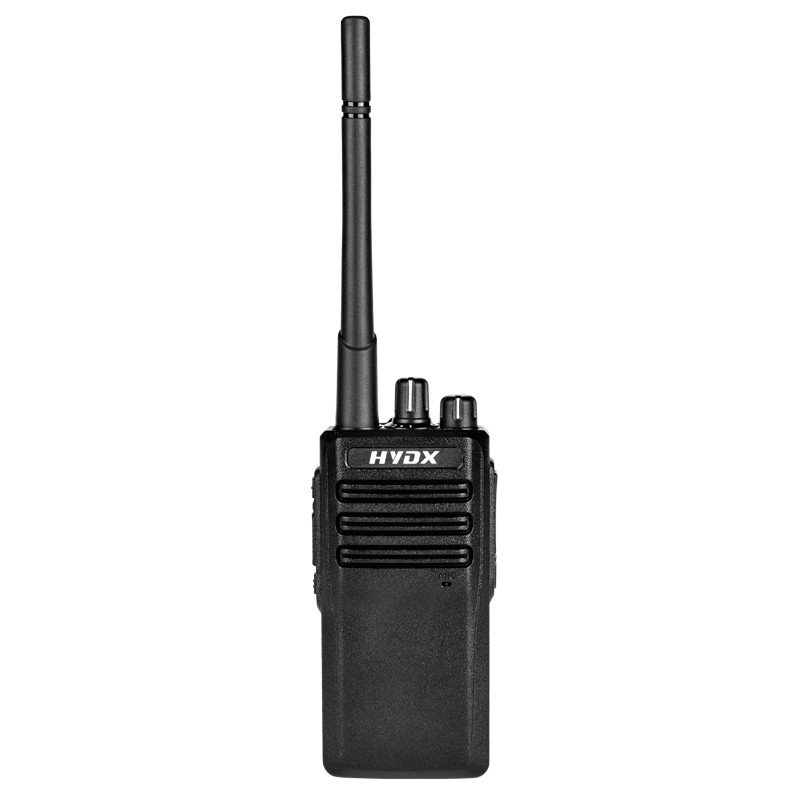
HYDX professional handheld digital two-way radio
DMR TDMA refers to the Time Division Multiple Access technology used in Digital Mobile Radio systems. It allows multiple communication transmissions to share the same radio frequency channel by assigning each transmission a specific time interval.
Under the DMR standard, a 12.5 kHz radio channel is divided into two alternating time slots. Each slot provides a separate logical communication path, allowing two independent calls or communication groups to use the same frequency channel when the system is correctly configured.
In simple terms, TDMA does not create two separate physical frequency channels. Instead, it divides access to one frequency channel according to time.
This is one of the main reasons why DMR is widely used in professional two-way radio systems. It helps organizations manage multiple communication groups without requiring a separate frequency channel for every group.
To understand two-slot DMR technology, it is helpful to look at how a radio transmission is organized over time.
Instead of allowing different users to transmit continuously on separate frequencies, TDMA divides communication into repeating time intervals. Each interval is assigned to a specific communication path.
In a standard DMR channel, the two slots are commonly identified as:
Compatible radios and infrastructure equipment synchronize their transmissions so that each device uses the appropriate time slot. This coordination allows both communication paths to operate on the same RF channel without intentionally transmitting over one another.
For example, a manufacturing facility could configure one communication group on Time Slot 1 for production personnel and another group on Time Slot 2 for maintenance staff. Both groups can use the same assigned frequency channel while maintaining separate communication paths.
DMR organizes transmission into repeating TDMA frames. Each frame contains two time slots, with each slot occupying approximately half of the frame duration.
The radio system uses timing synchronization and structured transmission bursts to ensure that signals are transmitted in their assigned intervals. This timing arrangement is essential for maintaining reliable two-slot communication.
The two slots are not two permanently separate frequencies. They are two time-based communication resources within the same frequency channel.
Frequency spectrum is a limited resource, particularly for professional land mobile radio services. Efficient spectrum utilization is therefore an important consideration when designing communication systems for businesses and public services.
DMR is designed around a 12.5 kHz channel arrangement. By applying two-slot TDMA, it provides two logical communication paths within that channel rather than assigning a separate 12.5 kHz channel to each path.
This arrangement is particularly useful for organizations that need several independent communication groups but have limited licensed frequency resources.
For example, a company operating a warehouse may need separate communication for inventory management, loading operations, and security. With a properly configured DMR system, multiple groups can be organized using available channels and time slots.
However, actual system capacity depends on frequency licensing, repeater configuration, traffic requirements, and equipment compatibility. Two-slot TDMA does not automatically double the physical coverage area or guarantee that every user can communicate simultaneously without limitations.
Two-slot TDMA provides several practical benefits for professional radio communication systems.
The ability to support two logical communication paths within one 12.5 kHz channel helps organizations use their assigned frequency resources more efficiently. This can be valuable in areas where frequency availability is limited or multiple departments need independent communication.
DMR allows users to be organized into individual communication groups. By assigning different talkgroups to different time slots, system administrators can manage department-level communication without necessarily requiring a separate frequency channel for every group.
DMR systems can be configured according to different operational requirements. Administrators can manage talkgroups, time slots, color codes, and channel assignments to create an organized communication structure.
TDMA provides the underlying channel-access mechanism, while the DMR standard also supports digital communication functions such as private calls, group calls, and data transmission. The exact available features depend on the radio model and system configuration.
For more information about available products, visit the HYDX DMR digital radio product range, which includes professional and commercial communication equipment.
DMR two-slot communication can be used in different operating configurations. Two important examples are Direct Mode and Repeater Mode.
Direct Mode allows compatible radios to communicate with each other without routing their communication through a repeater. It is also commonly called radio-to-radio or simplex communication.
Depending on the equipment and supported operating mode, DMR Direct Mode can provide one or two time-slot communication paths. Two-slot direct communication requires compatible radios and appropriate synchronization and configuration.
This arrangement can be suitable for smaller teams, temporary work areas, and operations where communication coverage does not require additional infrastructure.
A DMR repeater receives a transmission and retransmits it to extend communication coverage. In a Tier II conventional DMR system, a compatible repeater can support two time slots on its assigned frequency channel.
This makes repeater-based DMR systems useful for large factories, industrial facilities, logistics centers, and other environments where direct radio-to-radio communication may not provide sufficient coverage.
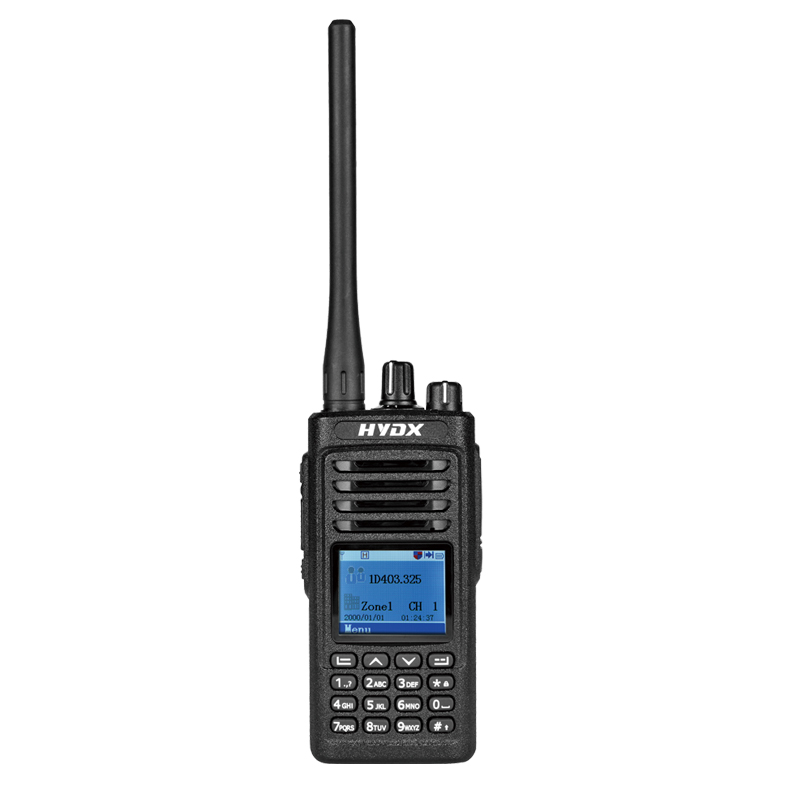
HYDX handheld DMR radio for professional communication applications
When selecting a repeater-based solution, businesses should verify the repeater's supported DMR standard, frequency range, time-slot configuration, and compatibility with the handheld radios. HYDX also offers a dedicated DMR digital repeater product category for communication system applications.
TDMA and Frequency Division Multiple Access (FDMA) are two different methods of sharing radio spectrum. Although both technologies can support multiple communication paths, they organize access to the frequency channel in different ways.
DMR uses TDMA, while dPMR is an example of a digital radio standard that uses FDMA.
| Comparison | DMR TDMA | dPMR FDMA |
|---|---|---|
| Access method | Divides access by time | Divides access by frequency |
| Channel arrangement | Two time slots in a 12.5 kHz channel | Two 6.25 kHz sub-channels within 12.5 kHz |
| Communication paths | Two logical time-based paths | Two frequency-based paths |
| Typical standard | DMR | dPMR |
| Key technology | Time Division Multiple Access | Frequency Division Multiple Access |
The main distinction is how the available spectrum is divided. DMR separates transmissions by time, whereas dPMR separates them by frequency.
Neither method is automatically better for every application. Equipment compatibility, network design, available frequencies, and the communication requirements of the organization should all be considered.
TDMA is a channel-access technology, not a direct measurement of radio range or audio quality. Its main contribution is the efficient organization of communication resources.
Several other technical factors determine the actual performance of a DMR handheld radio.
Digital communication also behaves differently from analog communication when signal strength decreases. DMR can maintain intelligible audio within its usable digital coverage area, but when signal conditions become too poor, digital audio may break up or communication may be lost.
Therefore, a radio with TDMA technology should not automatically be considered a long-range radio. Actual coverage must be evaluated according to the operating environment and system design.
HYDX provides professional digital two-way radios designed for commercial and industrial communication applications. Its product portfolio includes DMR equipment with digital and analog operating modes, repeater compatibility, and different communication functions depending on the model.
Some HYDX products explicitly list DMR Tier II repeater operation and TDMA support in their product specifications.
The HYDX D50 is a commercial handheld digital two-way radio supporting analog and digital transmission. Its published specifications include a 12.5 kHz channel spacing, 4FSK digital modulation, repeater operation, and DMR Tier I and Tier II compatibility.
It also supports private, group, and all-call functions, making it a model worth considering for commercial communication systems that require organized digital calling.
HYDX D50 commercial digital two-way radio
View the HYDX D50 commercial DMR radio specifications for more information about its supported functions and technical parameters.
The HYDX D35Plus is another professional digital radio in the HYDX product range. According to its product specifications, it supports repeater TDMA Tier II modes and provides 64 channels, 10,000 digital contacts, and digital and analog operating modes.
Optional ARC4, AES128, and AES256 encryption, as well as optional recording, are also listed among its features. These functions can be relevant to organizations with more demanding communication management requirements.
The D35Plus demonstrates how TDMA-compatible radio operation can be incorporated into a broader professional communication product with additional calling, security, and recording functions.
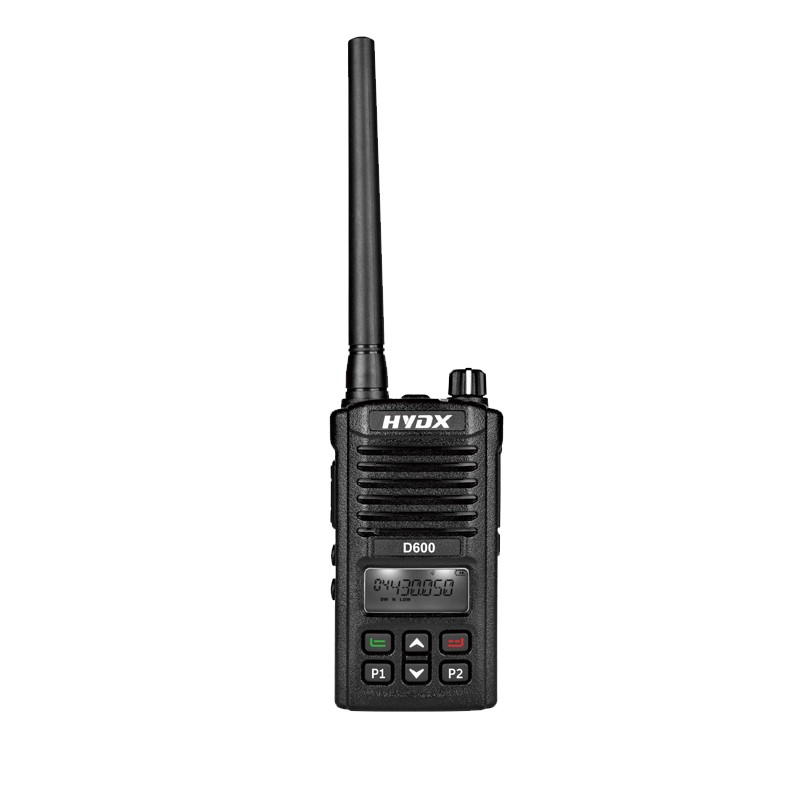
HYDX professional digital radio product design
For detailed specifications, visit the HYDX D35Plus professional digital radio page.
Although DMR TDMA provides an efficient way to organize communication, successful deployment requires more than choosing a compatible handheld radio.
Businesses and system integrators should evaluate the following technical details before building or expanding a DMR network:
For example, a logistics company may assign warehouse operations to one talkgroup and security personnel to another. By planning the time slots and talkgroups correctly, the organization can create a more structured communication system without unnecessarily consuming additional frequency resources.
DMR TDMA is an important technology behind modern professional digital radio communication. By dividing a 12.5 kHz channel into two alternating time slots, it provides two logical communication paths and helps organizations use available radio spectrum more efficiently.
Its practical value comes from more than simply having two slots. When combined with compatible handheld radios, repeaters, talkgroups, and proper system programming, DMR TDMA provides a flexible foundation for professional communication networks.
For businesses looking to build or upgrade a digital radio system, understanding the difference between TDMA, FDMA, Direct Mode, and Repeater Mode is an important step toward selecting compatible equipment.
HYDX offers a range of DMR digital radios for commercial and professional applications. Contact the HYDX team to discuss compatible radio models and communication solutions for your project.
TDMA stands for Time Division Multiple Access. In DMR, it divides a 12.5 kHz frequency channel into two alternating time slots, allowing two logical communication paths to share the same channel.
Standard DMR two-slot TDMA uses two time slots, known as Time Slot 1 and Time Slot 2, within one 12.5 kHz channel.
Two independent calls or communication groups can use the two time slots simultaneously, provided the DMR system and equipment support the configuration. Each time slot carries its own communication path.
No. TDMA improves frequency utilization by providing two logical communication paths within one channel. It does not automatically double transmission distance or signal coverage.
DMR TDMA separates communication by time, using two time slots in a 12.5 kHz channel. FDMA separates communication by frequency, such as dividing a 12.5 kHz channel into two 6.25 kHz sub-channels in dPMR systems.
Yes. Compatible DMR radios can communicate directly in Direct Mode without a repeater. Depending on the radio and configuration, direct communication can support one or two time slots.
A DMR repeater receives and retransmits radio signals to extend coverage. In a compatible Tier II system, it can support two time slots on the assigned frequency channel.
Yes. HYDX product specifications list DMR Tier II repeater TDMA support on models including the D50 and D35Plus. Users should check each model's specifications and configuration requirements before deployment.

SUBSCRIBE TO JUSTON E-NEWSLETTER :
Tel : +86 15906081133
Email : seven@odmradio.com
Whatsapp / Wechat : +86 15906081133
No.886 Changfeng Street, Licheng District, Quanzhou,Fujian,China


SCAN IT HYDX WECHAT :