When choosing walkie-talkies, selecting between UHF and VHF bands is a key consideration for many buyers and on-site operators. Neither band is absolutely better than the other; they have significantly different signal propagation characteristics. Only by matching the band to the actual working scenario can you ensure stable and reliable communication and avoid issues like weak signals or communication interruptions.
1. Basic Principles of the Bands
VHF (Very High Frequency, 136–174 MHz): Longer wavelengths with strong diffraction performance, making it more suitable for propagation along the surface of the earth and able to bypass natural obstacles like hills and dense forests.
UHF (Ultra High Frequency, 400–470 MHz): Shorter wavelengths, mainly line-of-sight propagation, making it easier to penetrate walls and gaps, which is advantageous in environments with many obstacles. However, the signal attenuates quickly when facing mountains or large vegetated areas.
A common misconception needs to be clarified: UHF's penetration advantage does not mean a longer communication distance; VHF's excellent diffraction ability does not mean it always has the best communication distance. In open, unobstructed environments, the height of the antenna is the key factor determining communication range.
2. Key Performance Comparison
Communication Distance
With the same transmission power and antenna conditions, VHF typically has a longer communication distance in open outdoor scenarios. The longer wavelength has lower ground transmission loss, making it suitable for wide-area inspections in open fields, coastlines, and forested areas. UHF signal decays faster in open environments, so under the same conditions, the communication distance is relatively shorter.
Obstacle Penetration
In environments with many walls or steel structures, such as factories, office buildings, warehouses, underground garages, and tunnels, UHF is the preferred choice. The shorter wavelength signal can penetrate concrete and brick wall gaps, providing more stable communication in enclosed or multi-partitioned spaces.
VHF excels at bypassing natural obstacles like hills and trees but suffers significant signal loss when facing thick walls or dense steel structures, making it unsuitable for complex indoor environments.
Antenna and Interference Characteristics
VHF antennas are generally larger, with longer antennas on handheld devices, which can be more susceptible to long-distance broadcast interference in urban areas.
UHF antennas are compact and easy to integrate into handheld radios. They offer a wide range of device options, abundant spectrum resources, and easier management of co-channel interference in urban settings.
3. Reference for Applicable Scenarios
Recommended to use VHF:
For forest fire patrols, mountain and field inspections, grassland operations, near-sea and river navigation communication, open-pit mines, outdoor search and rescue, long-distance outdoor projects, and other large outdoor areas with hills or tree obstructions.
Recommended to use UHF:
For industrial parks, steel-structured workshops, storage centers, commercial complexes, building security, underground spaces, urban construction sites, and other mixed indoor and outdoor areas with many walls.
4. Important Notes
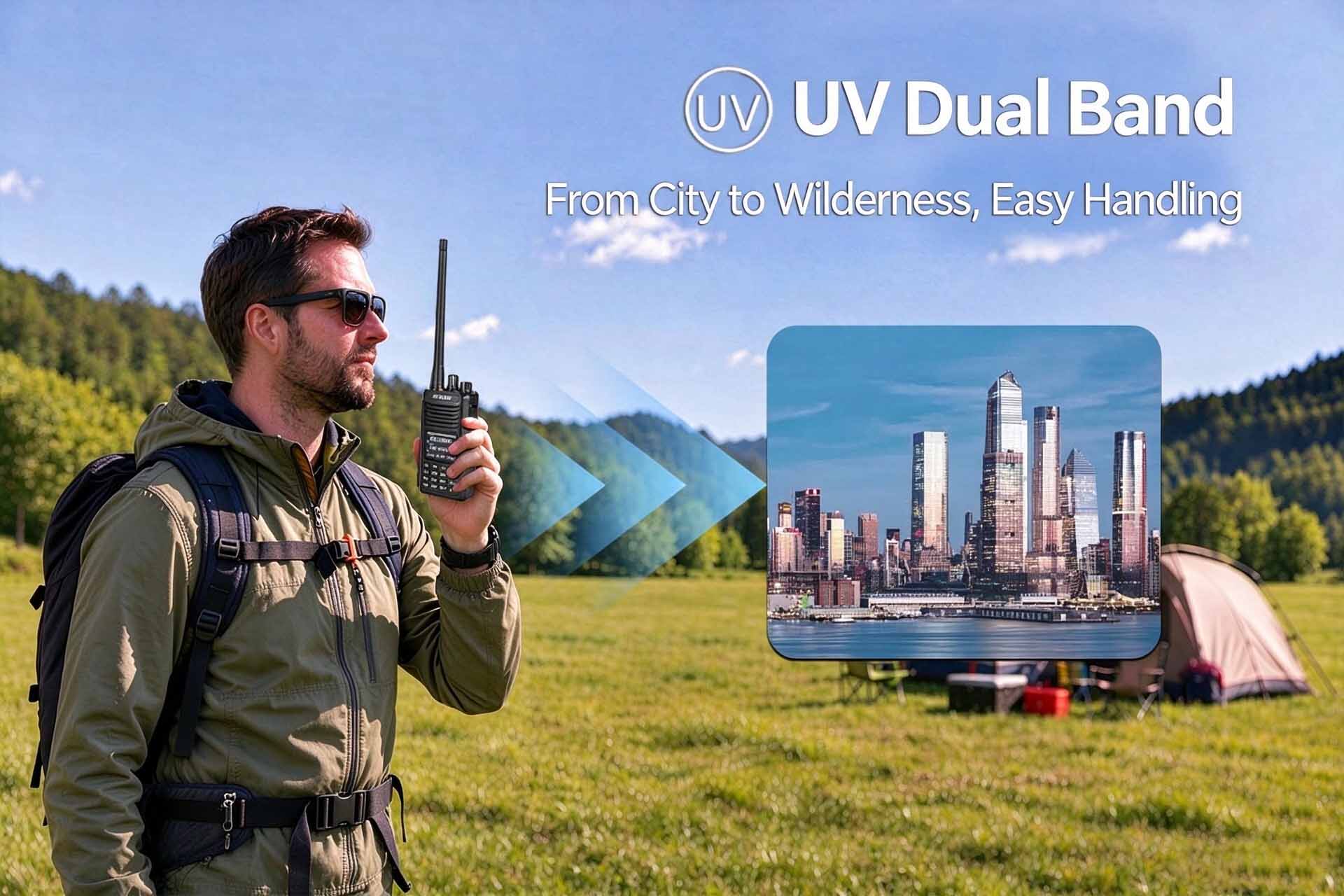
1. If your work involves both indoor and mountainous outdoor environments, consider a dual-band walkie-talkie to cover communication needs for both types of environments.
2. Communication distance is determined by multiple factors: besides the frequency band, transmission power, antenna gain, installation height, environmental noise, and obstacles all affect communication performance. Relying solely on the frequency band can't guarantee long-distance communication.
3. For special industry scenarios like explosion-proof or maritime communication, devices need to meet corresponding industry certification standards in addition to frequency band considerations. You can't choose a device based only on whether it uses UHF or VHF.
5. Summary
For mountain and forest areas, open fields, and long-distance outdoor communication, where diffraction and long-range transmission matter → Prioritize VHF.
For factories, buildings, underground spaces, and complex indoor scenarios with dense walls, where penetration ability matters → Prioritize UHF.
6. Recommended HYDX Models
1. For work scenarios mainly in factories, warehouses, commercial buildings, and underground garages with many walls and steel partitions, it’s best to go with UHF single-band radios. You can choose models like our Q608, Q610, Q650, which leverage the excellent signal penetration of the UHF band. They ensure stable and reliable communication in multi-story buildings and densely partitioned environments, meeting everyday communication needs for campus security, workshop dispatch, and indoor coordination on construction sites.
2. For forest patrols, mountain operations, grassland inspections, or riverside and near-sea communication in open but obstructed outdoor areas by hills or trees, VHF is more suitable. You can choose models like our A2 and A800, which make full use of VHF long-wavelength diffraction advantages to reduce signal loss caused by mountains and vegetation, ensuring smooth long-distance communication in large outdoor areas.
3. If your work environment isn’t fixed, alternating between indoor partitioned communication and outdoor forest patrols, a single-band radio can’t meet both needs. You can choose models like A910 and A2000Plus. These devices support UHF and VHF dual-band transmission and dual standby, allowing you to switch bands as needed: use UHF for penetration communication when entering factories or underground spaces, and switch to VHF to achieve long-distance diffraction communication in mountains and wilderness.